


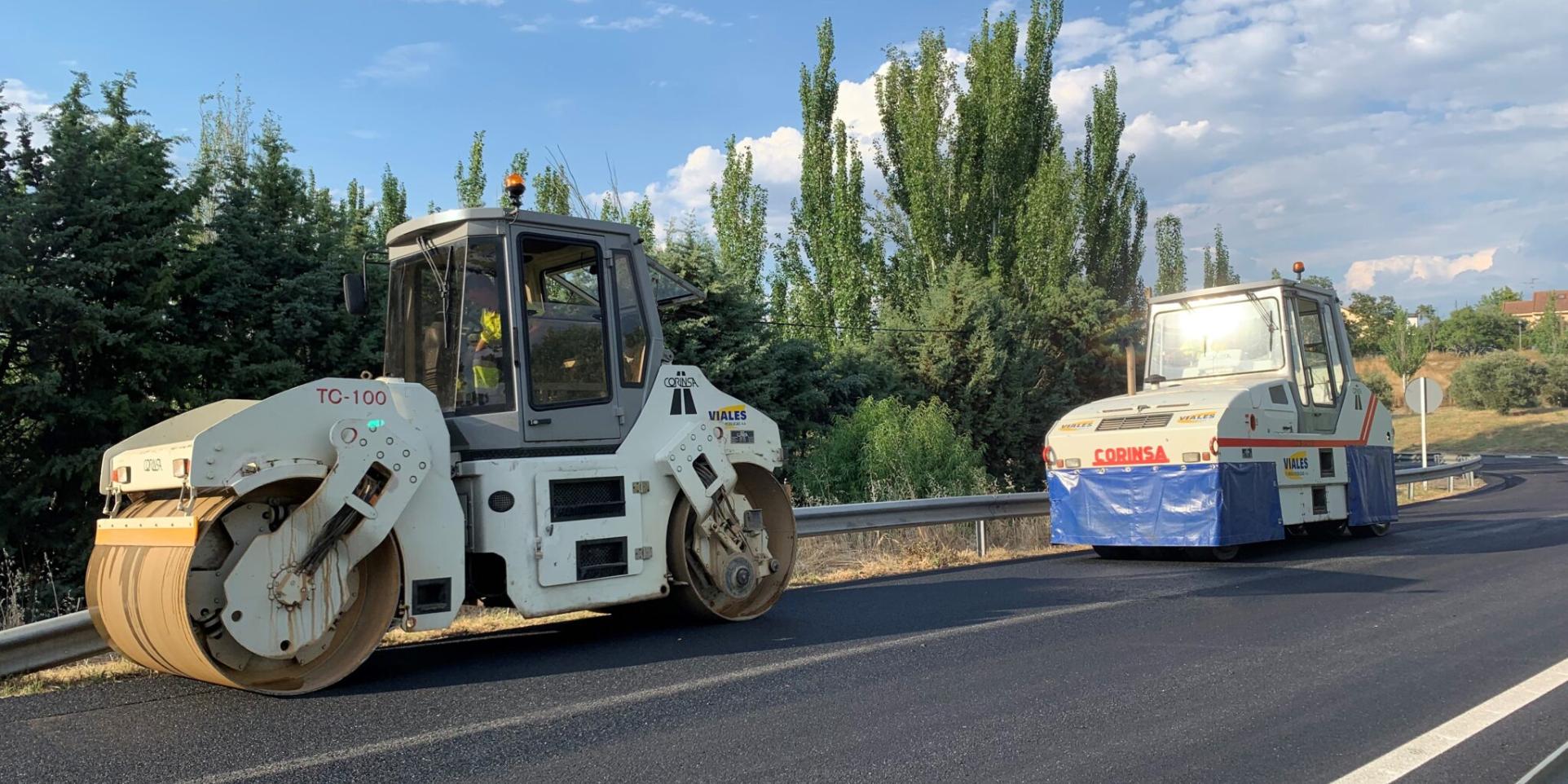
One of the most delicate and important tasks in the application of asphalt pavement is its compaction, as the final quality of the pavement largely depends on it. The goal is to achieve a high density that guarantees the expected durability and prevents surface irregularities. Compaction must reach the densification specified in the Specific Technical Specifications, typically between 95 and 98% of the reference Marshall density, while maintaining the surface geometry specified by the paver.
Compaction should always be carried out when the workability of the mix is sufficient. In hot mixes, compaction should begin at the highest possible temperature (above 120°C), provided the compactor’s load can be supported without curling or cracking. In cold mixes, there must be sufficient fluidizing agents in open mixes or the emulsion water itself in dense mixes.
The factors that influence the compaction of an asphalt agglomerate are, among others, the following:
- Type of pavement: Each type of mix will present different difficulties for compaction, for example, fracturing, size, and shape of the aggregates.
- Surface finish: Depending on the quality of the required finish, compaction must be carried out differently.
- Bitumen content: Bitumen acts as a lubricant between the particles, although it should not be excessive to avoid mix instability.
- Filler proportion and type: The higher the filler content, the more difficult compaction is, as it acts as a stabilizer for the bitumen.
- Layer thickness: Although a thicker layer produces better performance, the thickness is usually determined by the project.
- Temperature: The compaction temperature of a hot mix is always much higher than ambient temperatures, so it cools quickly, preventing subsequent compaction. However, it is also not advisable to overheat, as this causes mix instability. The following values can be given for practical purpose.
- Plant exit temperature: 135-180º
- Paver exit temperature: 120-150º
- Temperature during compaction: 85-150º
The first compaction is performed by the paver itself, achieving 80% of the theoretical Marshall density with its vibration. Although this figure seems high, it is low enough to require compaction with specific machinery.
The first areas to be compacted are the transverse joints, longitudinal joints, and the outer edge, in that order. In the case of the transverse joints, compaction is performed perpendicular to the centerline of the roadway. Once the joints and edge have been compacted, compaction of the roadway begins in the lowest area, progressing to the highest by overlapping successive passes. In areas with difficult access, small mechanical compactors or even manual tampers must be used.
The type of compactor required will depend on the type of mix and its thickness. In some cases, a test section is required to determine the characteristics of the compactors and the number of passes required. Typically, pneumatic compactors with high or medium pressure and smooth rollers with or without vibration are used.
Compaction is usually performed by combining different equipment. The most common combination is a pneumatic compactor, which compacts the mixture by kneading, and a metal-rim compactor, which smooths out any marks or ruts left by the previous equipment.
With pneumatic tyre rollers, work should be done at moderate pressures initially, with higher pressures to complete compaction. Furthermore, they will have smooth wheels, in a number, size, and arrangement that allows the front and rear wheels to overlap, with protective canvas skirts to prevent the tires from cooling. Compaction will depend on the total load per wheel, tire pressure, and stiffness, which determines the contact pressure. There is a kneading effect, and the compaction effect at depth is greater than that of metal rollers.
Vibratory tandem rollers are widely used, except for thin layers, by appropriately combining amplitudes and frequencies. These compactors operate at higher frequencies than those used for soils, above 2,000 rpm, in the range of 2,500 to 3,000 rpm, as lower frequencies significantly reduce their effectiveness. They also use smaller eccentric masses to meet the finishing and compaction requirements. The first passes are usually performed at low frequencies. For thick layers, high amplitudes and low frequencies are usually used, while for thin layers, the opposite is true.
By: Víctor Yepes Piqueras
Doctor Ingeniero de caminos, canales y puertos